


Context
Email was one of Europcar’s key communication channels throughout the customer journey, supporting confirmations, reminders and retention.
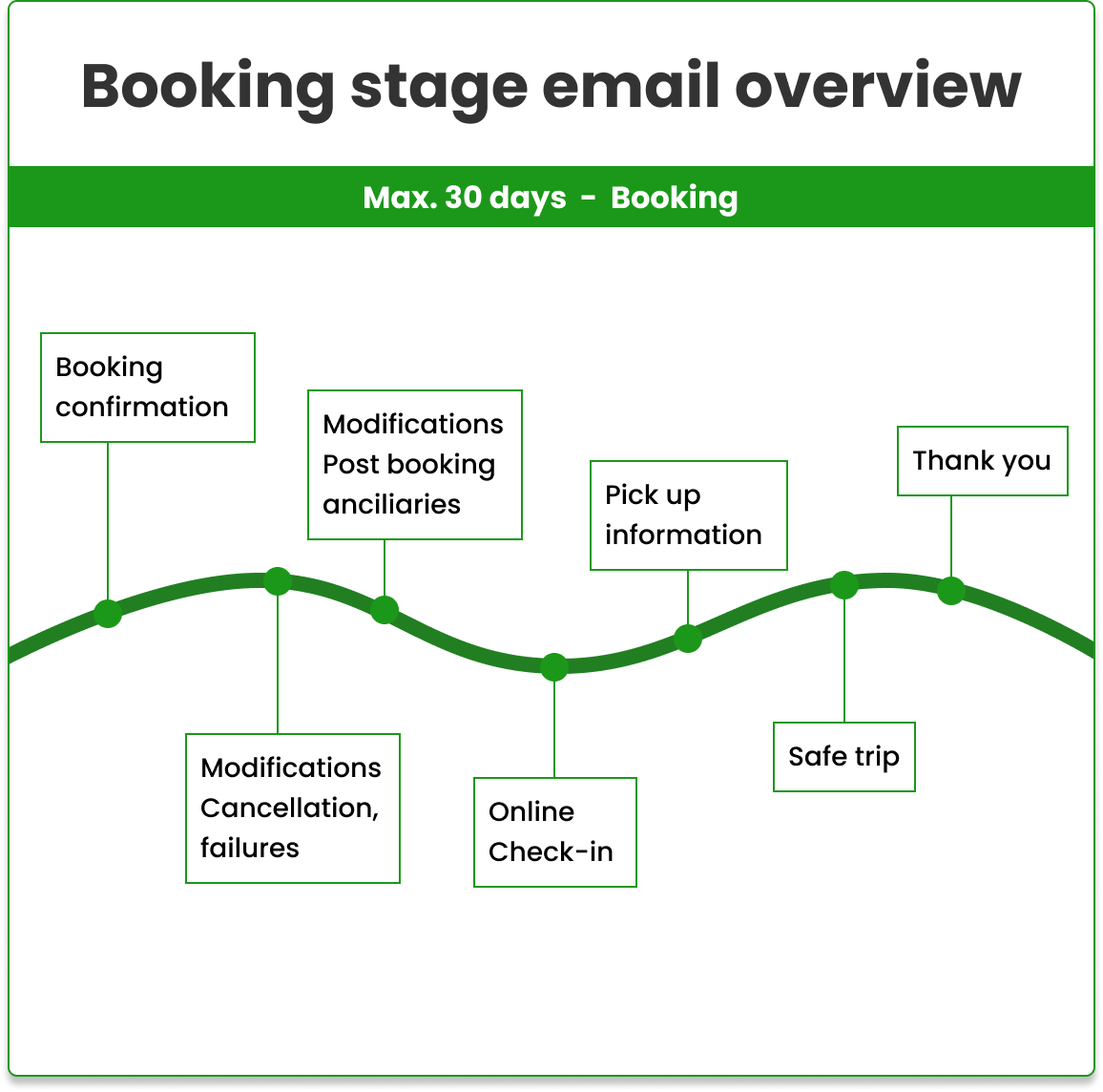
Over time, these communications were created by different teams and tools, responding to specific needs rather than a shared system. The project started by mapping key touchpoints to understand the existing communication landscape before defining any design solution.
The initiative involved multiple stakeholders across CRM, marketing and operations.
- Duplication of emails around the same booking moment
- Distributed ownership across multiple teams
- Lack of shared structure and hierarchy across email communications
Problem
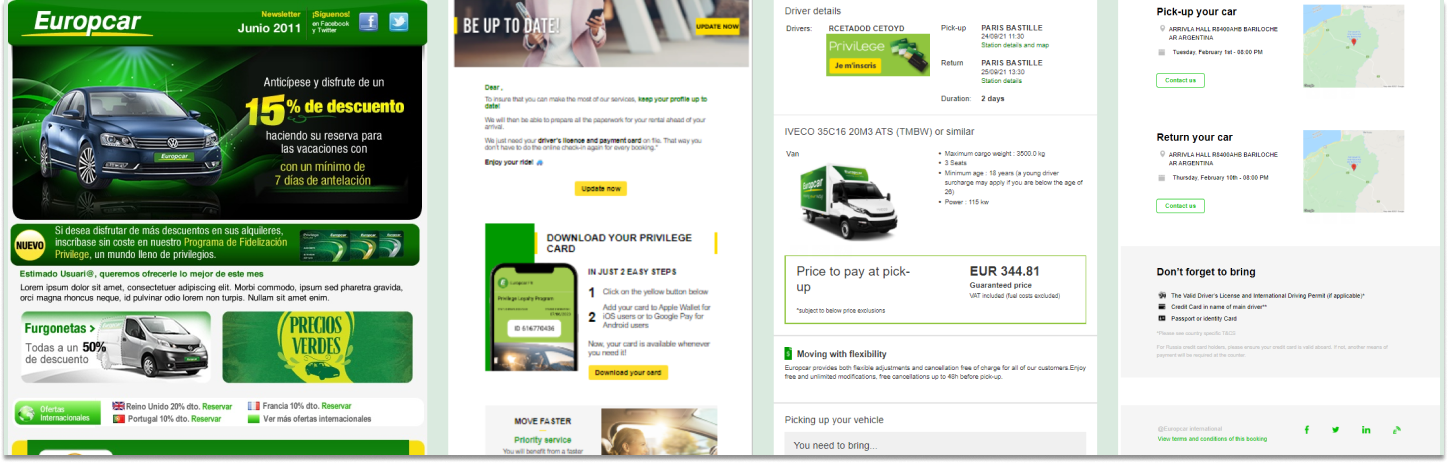
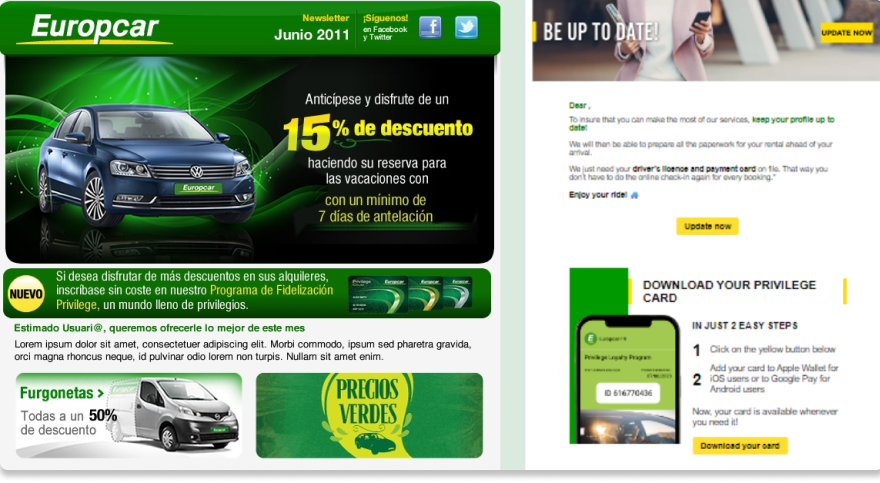
As email communications scaled across teams and use cases, the lack of a shared system led to fragmentation, inefficiencies and an inconsistent brand experience.
As a result, visual and structural consistency was lost. Emails varied significantly in layout, hierarchy, tone and branding, creating a fragmented experience and weakening the perception of a premium brand.
Without a shared system, maintaining quality, consistency and scalability became increasingly difficult.
Objectives
Design and business goals
The goal of this project was to establish consistency and structure to Europcar’s email communications, while improving scalability and supporting a premium brand experience.
Primary Objectives
- Establish a unified and consistent email system across touchpoints
- Improve clarity and hierarchy across all transactional, lifecycle and marketing email communications
- Enable teams to scale and maintain email communications more efficiently
Success metrics
Defined in collaboration with CRM and marketing teams to evaluate the effectiveness of the new email system.
- Open rate on key transactional and lifecycle emails
- Click-through rate (CTR) on primary CTAs
- Unsubscribe rate
- Customer satisfaction indicators related to communications (CSAT / NPS)
Strategy
Rather than redesigning individual emails, the focus of this project was to define a shared system that could support multiple teams, use cases and stages of the customer journey.
The strategy was built around creating a modular, scalable foundation that balanced brand consistency with flexibility for different communication needs.
Key strategic decisions
- Shift from isolated email designs to a component-based system
- Define a clear structure and hierarchy adaptable to different email types
- Separate content, layout and visual components to enable scalability
- Align design decisions with both brand guidelines and operational constraints
Process overview
- Email audit across key touchpoints
- Cross-team alignment workshops
- Review of existing templates and guidelines
System architecture
By defining a clear system architecture — including reusable components, layout rules and visual principles — the goal was to provide consistency, scalability and long-term maintainability across all email communications.
This artefact acted as a shared reference across teams, enabling alignment and decision-making at scale.

System principles
Consistency over customisation
- Ensure a unified look and feel across all email communications, prioritising brand consistency over ad-hoc custom designs
Modularity and reusability
- Build emails using reusable components that can be combined and adapted across different use cases and teams
Scalability by design
- Enable the system to grow and support new email types, triggers and business needs without increasing complexity
Clear hierarchy and readability
- Define strong visual and content hierarchy to improve comprehension, usability and overall communication effectiveness
Core components
The email system was built around a set of core, reusable components designed to cover the majority of communication needs across use cases, while balancing brand consistency with operational flexibility across markets and teams.

Final solution
The final solution demonstrates the application of the email design system across transactional, lifecycle and selected marketing communications. The system was progressively rolled out, with several templates implemented before the end of the project.

Impact & results
At the time of my departure from the company, the email design system was partially implemented, with several communications already built using the new structure. While the system was not fully rolled out, early implementation showed clear benefits.
Early outcomes and observed impact
- Immediate improvement in visual and structural consistency across newly created emails
- Clarified shared understanding of layout, hierarchy and components across teams
- Reduced need for ad-hoc design decisions during email creation
Qualitative impact
- Strengthened the perception of a cohesive and premium brand experience
- Accelerated alignment between design, CRM and operational teams
- Established a solid foundation for scaling and measuring email communications consistently over time
Learning & reflections
- Designing systems rather than individual outputs enables long-term consistency, scalability and team autonomy.
- Aligning cross-team alignment is as critical as visual design when building shared communication systems.
- Validating systems early, even through partial implementation, helps demonstrate value quickly through improved consistency and reduced friction
Let’s get in touch!
Feel free to reach out via email at paula.bernal.carro@gmail.com or connect with me on LinkedIn.