
KPIs & success metrics
To evaluate the impact of this early-stage, non-clinical mental health product, success
was framed around
engagement, behavioural adherence, perceived emotional support and ethical safety.
Metrics are benchmark-based and reflect expected outcomes rather than measured results.
Success metrics were intentionally framed as proxy indicators rather than clinical outcomes. They reflect behavioural adoption, perceived emotional support and ethical safety in an early-stage, non-clinical context, not therapeutic effectiveness.
Product engagement
- Measure activation through completion of the first check-in within 24h
- Track weekly active usage across app or robot interactions
Behavioural adherence
- Assess completion of suggested low-effort activities
- Monitor drop-off after the first week of usage
Perceived emotional support (self-reported, non-clinical)
- Capture self-reported emotional state variation after interaction
- Evaluate perceived emotional support using a qualitative scale
Trust & ethical safety
- Assess user trust and sense of safety
- Identify absence of dependency or intrusive interaction patterns
Hybrid system value
- Compare preference for app + robot versus app-only experience
- Evaluate perceived continuity of support beyond the screen
Context & problem space
Depression is a long-term mental health condition that often extends beyond clinical settings, leaving
people without continuous everyday emotional support. Outside therapy sessions, maintaining routines,
motivation and emotional regulation can be especially challenging.
Most existing digital solutions focus on content or self-tracking, while offering limited sense of
presence or continuity. Hybrid physical–digital tools are not designed for constant use,
creating a
gap between professional care and daily emotional needs.
This project explores that gap by investigating how a non-clinical, hybrid support system could provide lightweight, ongoing emotional support without increasing dependency or cognitive load. This project deliberately frames emotional wellbeing as a product design challenge rather than a therapeutic one. The problem space was intentionally constrained to non-clinical, low-intensity emotional support, focusing on moments of emotional friction where professional intervention is not required but emotional containment is still valuable.
Problem space
For people living with depression, the core challenge is sustaining small, manageable actions over time without feeling overwhelmed, judged or emotionally dependent on the product. The core product challenge was not to increase engagement or behavioural change, but to support small, manageable actions without creating emotional dependency or cognitive overload.
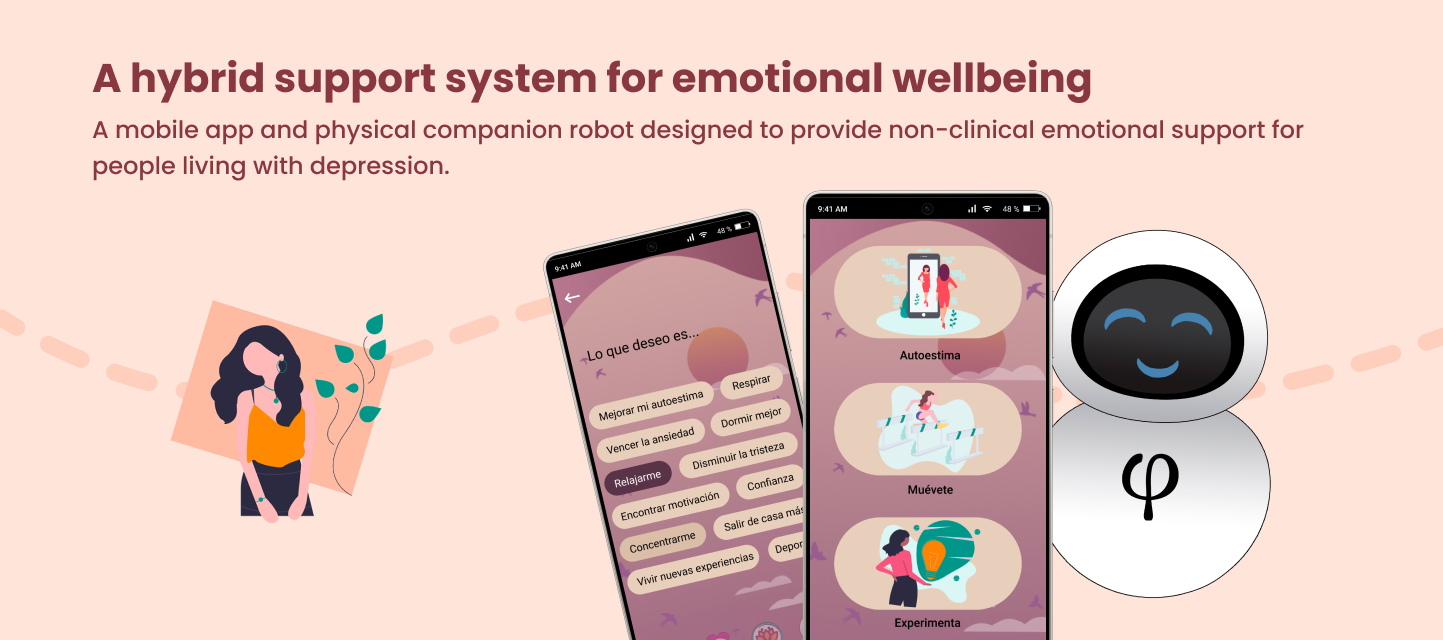
The proposed approach combines:
- Provide a lightweight digital interface for guidance and reflection
- Extend perceived emotional support beyond the screen through a physical companion
Boundaries & constraints
From the outset, the project was intentionally framed with strict boundaries to avoid clinical overreach and emotional dependency.
- Excluded clinical diagnosis, treatment or long-term mental health monitoring by design
- Prioritised user autonomy and emotional containment over behavioural control or optimisation
- Focused on trust, perceived support and ethical safety rather than medical or therapeutic outcomes
Given the hybrid physical–digital nature of the product, scalability was intentionally not treated as a primary success factor. The physical companion was conceived as a low-complexity artefact, prioritising emotional presence over technical sophistication. This project deliberately accepts limited scalability in exchange for higher perceived emotional continuity and ethical safety.
Research & insights
Research focused on understanding how people living with depression experience emotional support outside clinical settings, and where existing digital solutions fail to sustain engagement over time.
Using qualitative, exploratory methods, research captured behaviours, perceptions and unmet needs around daily emotional support. Findings were synthesised through affinity mapping to identify recurring patterns and decision drivers.
Key insights
- Struggle to maintain small routines consistently during low-energy moments
- Feel overwhelmed by solutions that require high cognitive or emotional effort
- Miss a sense of presence and continuity beyond active screen use
- Avoid tools that feel judgmental, intrusive or overly clinical

Insight synthesis
Research revealed a clear gap between structured clinical support and everyday emotional needs. While users value guidance and reflection, sustained engagement depends on low-effort interactions and a sense of companionship that does not increase dependency.
These insights informed the decision to explore a hybrid support system, combining a lightweight digital interface with a physical presence to extend emotional support beyond the screen.
Research insights were deliberately translated into constrained design decisions rather than feature expansion. Given the sensitive, non-clinical context, the system prioritises emotional containment and low cognitive load over continuous engagement or behavioural optimisation.
- Avoided proactive or persistent interventions to prevent dependency or emotional overreach.
- Deprioritised long-term emotional tracking, favouring short, contextual interactions instead.
- Accepted limited engagement depth in exchange for higher perceived safety and trust.
Design principles
Design principles were intentionally defined as constraints rather than aspirational guidelines. Given the sensitive, non-clinical context, each principle prioritises emotional safety, autonomy and ethical responsibility over engagement, persuasion or optimisation.
- Emotional containment over stimulation
Interactions were deliberately designed to remain emotionally contained, avoiding high-arousal patterns, gamification or persuasive feedback that could intensify emotional dependency. - User autonomy over behavioural control
The system supports user-initiated actions only, intentionally avoiding nudges, reminders or proactive prompts that could reduce perceived autonomy. - Low cognitive load by default
Content, interactions and decision paths were intentionally simplified to minimise cognitive effort during emotionally vulnerable moments. - Trust and predictability over novelty
Interaction patterns prioritise consistency and predictability to build trust, rather than novelty-driven engagement or dynamic content variation. - Ethical safety as a design constraint
Every interaction was evaluated against potential risks of dependency, emotional overreach or misinterpretation, favouring conservative design decisions when uncertainty existed.
Strategy
The strategy deliberately prioritised emotional continuity over functional completeness. Rather than optimising for frequent interaction or feature density, the system was designed to remain present across different energy levels and moments of emotional friction, without increasing dependency or cognitive load.
Responsibilities were intentionally distributed across the digital and physical layers to balance autonomy, non-intrusiveness and perceived emotional support, accepting reduced functionality in exchange for ethical safety and trust.
Mobile app
- Provide lightweight guidance, reflection and emotional check-ins within a non-clinical frame
- Support self-awareness without encouraging tracking, performance or behavioural optimisation
Physical component
- Extend perceived emotional presence beyond screen-based interaction
- Reinforce continuity through low-effort, non-demanding interactions rather than reminders or prompts

Key design decisions

Key design decisions prioritised emotional safety, cognitive simplicity and clear interaction boundaries over engagement depth or behavioural optimisation.
- Design for low-effort interaction by default
Core interactions were intentionally short, guided and lightweight to accommodate low-energy moments without overwhelming the user. - Guide without pressuring or gamifying emotional actions
Activities provide clear direction and closure without performance metrics, streaks or rewards that could introduce pressure or guilt. - Limit decision-making during vulnerable moments
Choices were reduced to simple, binary actions to minimise cognitive load while maintaining a sense of control. - Provide clear emotional closure after each interaction
Each activity ends with a calm, explicit completion state to reinforce progress without exaggerating achievement. - Support emotional continuity without creating dependency
The interaction model prioritises optional engagement and clear endings, avoiding continuous loops or intrusive prompts.
Validation & outcomes
As an early-stage, non-clinical project, validation focused on identifying qualitative outcomes and early behavioural signals rather than measuring quantitative or clinical success metrics. The goal was to assess whether the hybrid system felt supportive, safe and appropriate in everyday use, while maintaining clear ethical boundaries and avoiding dependency.
User testing and exploratory validation were designed to observe how people engaged with low-effort activities, how comfortable they felt stopping interaction, and how the combination of digital guidance and physical presence was perceived over time.
Observed outcomes from user testing
- Report feeling supported without pressure or obligation to continue interacting.
- Describe the guided routines as easy to start and easy to stop during low-energy moments.
- Express higher comfort levels with optional, non-intrusive interactions compared to reminder-driven tools.
- Perceive the physical companion as reinforcing presence rather than replacing human support.
Success indicators (early-stage)
- Observe voluntary engagement across multiple sessions without external prompts
- Maintain trust through clear non-clinical framing and transparent boundaries.
- Avoid dependency signals such as anxiety when stopping usage or missing interactions.
Learnings & next steps
This project reinforced the importance of designing emotional support systems that prioritise low cognitive load, ethical boundaries and user autonomy. Working within a non-clinical context highlighted how small, carefully framed interactions can provide perceived support without creating dependency or pressure.
Learnings
- Validate that low-effort, guided interactions reduce cognitive load during low-energy moments.
- Confirm that clear endings and optional engagement help prevent emotional dependency.
- Observe that combining digital guidance with physical presence strengthens perceived continuity of support.
- Reinforce the importance of explicit non-clinical framing to build trust and ethical safety.
Next steps
- Test the hybrid system through short longitudinal pilots to observe engagement patterns.
- Refine robot behaviours to balance presence with minimal intrusion.
- Expand personalisation based on user preferences rather than mood prediction.
- Explore integration with external support resources while maintaining clear non-clinical boundaries.
Let’s get in touch!
Feel free to reach out via email at paula.bernal.carro@gmail.com or connect with me on LinkedIn.